Saturday, 10 December 2011

Record massive black holes discovered lurking in monster galaxies

Record massive black holes discovered lurking in monster galaxies
Published: Monday, December 5, 2011 - 21:19 in Astronomy & Space
An artist's concept of stars moving in the central regions of a giant elliptical galaxy that harbors a supermassive black hole.
Gemini Observatory/AURA artwork by Lynette Cook
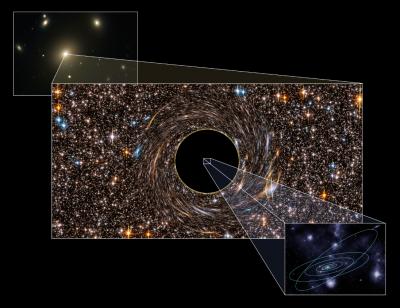
NGC 3842 (upper left) is the brightest galaxy in a rich cluster of galaxies. The black hole at its center (shown in middle as artist's concept) is surrounded by stars distorted by its immense gravitational field. The black hole, which is seven times larger than Pluto's orbit, would dwarf our solar system (inset).
Pete Marenfeld
University of California, Berkeley, astronomers have discovered the largest black holes to date ‑- two monsters with masses equivalent to 10 billion suns that are threatening to consume anything, even light, within a region five times the size of our solar system. These black holes are at the centers of two galaxies more than 300 million light years from Earth, and may be the dark remnants of some of the very bright galaxies, called quasars, that populated the early universe.
"In the early universe, there were lots of quasars or active galactic nuclei, and some were expected to be powered by black holes as big as 10 billion solar masses or more," said Chung-Pei Ma, UC Berkeley professor of astronomy. "These two new supermassive black holes are similar in mass to young quasars, and may be the missing link between quasars and the supermassive black holes we see today."
Black holes are dense concentrations of matter that produce such strong gravitational fields that even light cannot escape. While exploding stars, called supernovas, can leave behind black holes the mass of a single star like the sun, supermassive black holes have presumably grown from the merger of other black holes or by capturing huge numbers of stars and massive amounts of gas.
"These black holes may shed light on how black holes and their surrounding galaxies have nurtured each other since the early universe," said UC Berkeley graduate student Nicholas McConnell, first author of a paper on the discovery being published in the Dec. 8 issue of the British journal Nature by McConnell, Ma and their colleagues at the university of Toronto, Texas and Michigan, as well as by the National Optical Astronomy Observatory in Arizona.
To date, approximately 63 supermassive black holes have been found sitting in the cores of nearby galaxies. The largest for more than three decades was a 6.3 billion solar mass black hole in the center of the nearby galaxy M87.
One of the newly discovered black holes is 9.7 billion solar masses and located in the elliptical galaxy NGC 3842, the brightest galaxy in the Leo cluster of galaxies, 320 million light years away in the direction of the constellation Leo. The second is as large or larger and sits in the elliptical galaxy NGC 4889, the brightest galaxy in the Coma cluster about 336 million light years from Earth in the direction of the constellation Coma Berenices.
According to McConnell, these black holes have an event horizon -- the "abandon all hope" edge from which not even light can escape -- that is 200 times the orbit of Earth, or five times the orbit of Pluto. Beyond the event horizon, each black hole has a gravitational influence that would extend over a sphere 4,000 light years across.
"For comparison, these black holes are 2,500 times as massive as the black hole at the center of the Milky Way Galaxy, whose event horizon is one fifth the orbit of Mercury," McConnell said.
The brightest galaxy in a cluster
These 10 billion solar mass black holes have remained hidden until now, presumably because they are living in quiet retirement, Ma said. During their active quasar days some 10 billion years ago, they cleared out the neighborhood by swallowing vast quantities of gas and dust. The surviving gas became stars that have since orbited peacefully. According to Ma, these monster black holes, and their equally monster galaxies that likely contain a trillion stars, settled into obscurity at the center of galaxy clusters.
Ma, a theoretical astrophysicist, decided to look for these huge black holes in relatively nearby clusters of elliptical galaxies as a result of her computer simulations of galaxy mergers.
Astronomers believe that many, if not all, galaxies have a massive black hole at the center, with the larger galaxies harboring larger black holes. The largest black holes are found in elliptical galaxies, which are thought to result from the merger of two spiral galaxies. Ma found, however, that mergers of elliptical galaxies themselves could produce the largest elliptical galaxies as well as supermassive black holes approaching 10 billion solar masses. These black holes can grow even larger by consuming gas left over from a merger.
"Multiple mergers are one way to build up these behemoths," Ma said.
To look for these monster black holes, Ma teamed up with observational astronomers, including James Graham, a professor of astronomy at UC Berkeley and the University of Toronto, and Karl Gebhardt, a professor of astronomy at the University of Texas at Austin. Gebhardt had obtained the mass of the previous record holder in galaxy M87.
Using telescopes at the Gemini and Keck observatories in Hawaii and at McDonald Observatory in Texas, McConnell and Ma obtained detailed spectra of the diffuse starlight at the centers of several massive elliptical galaxies, each the brightest galaxy in its cluster. So far, they've analyzed the orbital velocities of stars in two galaxies and calculated the central masses to be in the quasar range. Having such huge masses contained within a volume only a few hundred light years across led the astronomers to conclude that the masses were massive black holes.
"If all that mass were in stars, then we would see their light," Ma said.
Modeling these massive galaxies required use of state-of-the-art supercomputers at the Texas Advanced Computing Center.
"For an astronomer, finding these insatiable black holes is like finally encountering people nine feet tall, whose great height had only been inferred from fossilized bones. How did they grow so large?" Ma said. "This rare find will help us understand whether these black holes had very tall parents or ate a lot of spinach."
Other coauthors of the Nature paper are Hubble postdoctoral fellow Shelley A. Wright at UC Berkeley and graduate student Jeremy D. Murphy of the University of Texas; Tod R. Lauer of the National Optical Astronomy Observatory; and Douglas O. Richstone of the University of Michigan.
The research was supported by the National Science Foundation, the National Aeronautics and Space Administration and UC Berkeley's Miller Institute for Basic Research in Science.

Source: University of California - Berkeley

Tuesday, 6 December 2011

ANOTHER EARTH?

WASHINGTON: In another step toward finding Earth-like planets that may hold life, NASA said on Monday the Kepler space telescope has confirmed its first-ever planet in a habitable zone outside our solar system.
French astronomers earlier this year confirmed the first rocky exoplanet to meet key requirements for sustaining life. But Kepler-22b, initially glimpsed in 2009, is the first the US space agency has been able to confirm.
Confirmation means that astronomers have seen it crossing in front of its star three times. But it doesn't mean that astronomers know whether life actually exists there, simply that the conditions are right.
Such planets have the right distance from their star to support water, plus a suitable temperature and atmosphere to support life.
"We have now got good planet confirmation with Kepler-22b," said Bill Borucki, Kepler principal investigator at NASA Ames Research Center.
"We are certain that it is in the habitable zone and if it has a surface, it ought to have a nice temperature," he told reporters.
Spinning around its star some 600 light years away, Kepler-22b is 2.4 times the size of the Earth, putting it in class known as "super-Earths," and orbits its Sun-like star every 290 days.
Its near-surface temperature is presumed to be about 72 degrees Fahrenheit (22 Celsius). Scientists do not know, however, whether the planet is rocky, gaseous or liquid.
The planet's first "transit," or star crossover, was captured shortly after NASA launched its Kepler spacecraft in March 2009.
NASA also announced that Kepler has uncovered 1,094 more potential planets, twice the number it previously had been tracking, according to research being presented at a conference in California this week.
Kepler is NASA's first mission in search of Earth-like planets orbiting suns similar to ours, and cost the US space agency about $600 million.
It is equipped with the largest camera ever sent into space -- a 95-megapixel array of charge-coupled devices -- and is expected to continue sending information back to Earth until at least November 2012.
Kepler is searching for planets as small as Earth, including those orbiting stars in a warm, habitable zone where liquid water could exist on the surface of the planet.
The latest confirmed exoplanet that could support life brings to three the total number confirmed by global astronomers.
In addition to French astronomers' confirmed finding of Gliese 581d in May, Swiss astronomers reported in August that another planet, HD 85512 b, about 36 light years away seemed to be in the habitable zone of its star.
However, those two planets are "orbiting stars smaller and cooler than our Sun," NASA said in a statement, noting that Kepler-22b "is the smallest yet found to orbit in the middle of the habitable zone of a star similar to our Sun."
"The Europeans have also been very active, actively working on confirming our candidates," said Natalie Batalha, Kepler deputy science team lead at San Jose State University.
"They have already confirmed two that are published and they have got another batch that are on the preprint servers so those will be, I'm sure, in the published literature soon," she added.
"So we are just thrilled about this. We need all telescopes observing these candidates so we can confirm as many as possible."
A total of 48 exoplanets and exomoons are potential habitable candidates, among a total of 2,326 possibilities that Kepler has identified so far.

Monday, 5 December 2011

neutrinos faster than the speed of light

More details on the "faster than the speed of light" neutrinos

                                        Last night, in response to a worldwide surge in interest, the OPERA experiment released a paper that describes the experiments that appear to show neutrinos traveling faster than the speed of light. And today, CERN broadcast a live seminar in which one of the work's authors described the content of the paper. Both of those emphasized the point of our initial coverage: figuring out whether anything is traveling beyond the speed of light requires incredibly accurate measurements of time and distance, and the OPERA team has made an extensive effort to make its work as accurate as possible.
As a spokesperson for the MINOS neutrino experiment told Ars yesterday, there are three potential sources of error in the timing measurements: distance errors, time-of-flight errors, and errors in the timing of neutrino production. The vast majority of both the paper and the lecture were dedicated to discussing how these errors were reduced (the actual detection of the neutrinos was only a small portion of the paper).
Neutrinos are produced using a proton beam from one of the accelerators that feeds them into the LHC. The protons hit a fixed target and produce unstable particles that decay, releasing a neutrino. The protons move close to, but not at the speed of light, as do the unstable pions; both of these effects were accounted for. The timing of the protons and structure of the two bunches of them used in these experiments is not even, either, so the researchers created a profile of the proton bunch. They also compensated for the timing of the kicker magnet that pushes the bunch out of the accelerator and added detectors that registered them passing through the hardware to get a clearer sense of their timing.
Similar work went into the detector side, where the time between an actual neutrino event and the signal propagating through the hardware and to a field programmable gate array (FPGA) where it was processed was estimated at about 50ns (the neutrinos only arrived 60ns early, so that 50ns is a substantial fraction of the total). But the error in their estimate was only ±2.3ns, as measured by shining a picosecond UV laser on the detector.
Distance travelled created its own problems. The positions of the hardware were measured via GPS, which normally doesn't provide the sort of precision needed for this work. But the labs did multiple samples of the GPS signals, threw out bad ones, compensated for the effect of the Earth's iononsphere, and more. Then, just to check their work, they had an outside team from a German standards institute come in and perform an independent analysis. The end result was a measurement sensitive enough to register both the steady change due to continental drift, as well as a 7cm jump triggered by an earthquake.
Then, the timing of all the events had to be synchronized. At each site, the group put a cesium-based atomic clock, and synchronized it with the GPS signal. Then, they sent a portable atomic clock between the facilities to check. They then ran photons through a fiber optic cable between them, just to make sure.
The end result is that the OPERA team doesn't see any obvious problems in its measurements. All of the errors, when added up, shouldn't be able to account for anything close to the 60ns gap between the neutrinos' arrival and the speed of light. The difference between their speed and that of light is very statistically significant, and the neutrino data itself looks excellent. The team has recorded over 16,000 events now, and the profile of events over time very closely matches the structure of the proton bunches that created them.
But that doesn't mean that this presentation is the last word on the topic. There are a lot of potential sources of error they know about—the paper's table lists a dozen of them. Small errors in each of these could add up to something more significant than their total error. Then there are the classic unknown unknowns. The authors have tried to think of everything, but it's not clear that they can.
The audience at the seminar was already thinking of other sources. For example, GPS signals don't actually penetrate down to the where any of the hardware is, meaning that this system has to track the hardware's motion a bit indirectly. This led one audience member to suggest "if this is a true measurement, drill a bloody hole." The speaker pointed out that commercial drilling equipment isn't accurate enough to go straight from the surface to the detectors, which are kept that deep to filter out most cosmic rays —in short, the solution would create another error.
The other reason that many are voicing skepticism are past measurements of neutrino speeds obtained from supernovae. Since these are so incredibly distant, the small signal seen here would be huge—the neutrinos should arrive roughly four years ahead of the photons. Other experiments on Earth also suggested insignificant differences. One possible explanation for this is the energy of the neutrinos, since OPERA uses much higher energy than the other sources. But the paper indicates that's not likely to be the case, since the authors saw the same signal with both 10 and 40GeV neutrinos.
In the meantime, the physics community will be looking through the paper, trying to spot unaccounted for sources of error. There are two other similar neutrino detectors in use—T2K and MINOS—and they'll undoubtedly be looking into working out the timing of their hardware with the same sort of thoroughness OPERA has.
The theorists, however, will undoubtedly be having a field day. It will be a while before anyone has the chance to test these results independently, giving theorists a chance to try to reconcile fast neutrinos with the rest of physics until then.

Saturday, 3 December 2011

Astronomers Find 18 New Planets

Astronomers Find 18 New Planets: Discovery Is the Largest Collection of Confirmed Planets Around Stars More Massive Than the Sun

ScienceDaily (Dec. 2, 2011) — Discoveries of new planets just keep coming and coming. Take, for instance, the 18 recently found by a team of astronomers led by scientists at the California Institute of Technology (Caltech).
"It's the largest single announcement of planets in orbit around stars more massive than the sun, aside from the discoveries made by the Kepler mission," says John Johnson, assistant professor of astronomy at Caltech and the first author on the team's paper, which was published in the December issue of The Astrophysical Journal Supplement Series. The Kepler mission is a space telescope that has so far identified more than 1,200 possible planets, though the majority of those have not yet been confirmed.
Using the Keck Observatory in Hawaii -- with follow-up observations using the McDonald and Fairborn Observatories in Texas and Arizona, respectively -- the researchers surveyed about 300 stars. They focused on those dubbed "retired" A-type stars that are more than one and a half times more massive than the sun. These stars are just past the main stage of their life -- hence, "retired" -- and are now puffing up into what's called a subgiant star.
To look for planets, the astronomers searched for stars of this type that wobble, which could be caused by the gravitational tug of an orbiting planet. By searching the wobbly stars' spectra for Doppler shifts -- the lengthening and contracting of wavelengths due to motion away from and toward the observer -- the team found 18 planets with masses similar to Jupiter's.
This new bounty marks a 50 percent increase in the number of known planets orbiting massive stars and, according to Johnson, provides an invaluable population of planetary systems for understanding how planets -- and our own solar system -- might form. The researchers say that the findings also lend further support to the theory that planets grow from seed particles that accumulate gas and dust in a disk surrounding a newborn star.
According to this theory, tiny particles start to clump together, eventually snowballing into a planet. If this is the true sequence of events, the characteristics of the resulting planetary system -- such as the number and size of the planets, or their orbital shapes -- will depend on the mass of the star. For instance, a more massive star would mean a bigger disk, which in turn would mean more material to produce a greater number of giant planets.
In another theory, planets form when large amounts of gas and dust in the disk spontaneously collapse into big, dense clumps that then become planets. But in this picture, it turns out that the mass of the star doesn't affect the kinds of planets that are produced.
So far, as the number of discovered planets has grown, astronomers are finding that stellar mass does seem to be important in determining the prevalence of giant planets. The newly discovered planets further support this pattern -- and are therefore consistent with the first theory, the one stating that planets are born from seed particles.
"It's nice to see all these converging lines of evidence pointing toward one class of formation mechanisms," Johnson says.
There's another interesting twist, he adds: "Not only do we find Jupiter-like planets more frequently around massive stars, but we find them in wider orbits." If you took a sample of 18 planets around sunlike stars, he explains, half of them would orbit close to their stars. But in the cases of the new planets, all are farther away, at least 0.7 astronomical units from their stars. (One astronomical unit, or AU, is the distance from Earth to the sun.)
In systems with sunlike stars, gas giants like Jupiter acquire close orbits when they migrate toward their stars. According to theories of planet formation, gas giants could only have formed far from their stars, where it's cold enough for their constituent gases and ices to exist. So for gas giants to orbit nearer to their stars, certain gravitational interactions have to take place to pull these planets in. Then, some other mechanism -- perhaps the star's magnetic field -- has to kick in to stop them from spiraling into a fiery death.
The question, Johnson says, is why this doesn't seem to happen with so-called hot Jupiters orbiting massive stars, and whether that dearth is due to nature or nurture. In the nature explanation, Jupiter-like planets that orbit massive stars just wouldn't ever migrate inward. In the nurture interpretation, the planets would move in, but there would be nothing to prevent them from plunging into their stars. Or perhaps the stars evolve and swell up, consuming their planets. Which is the case? According to Johnson, subgiants like the A stars they were looking at in this paper simply don't expand enough to gobble up hot Jupiters. So unless A stars have some unique characteristic that would prevent them from stopping migrating planets -- such as a lack of a magnetic field early in their lives -- it looks like the nature explanation is the more plausible one.
The new batch of planets have yet another interesting pattern: their orbits are mainly circular, while planets around sunlike stars span a wide range of circular to elliptical paths. Johnson says he's now trying to find an explanation.
For Johnson, these discoveries have been a long time coming. This latest find, for instance, comes from an astronomical survey that he started while a graduate student; because these planets have wide orbits, they can take a couple of years to make a single revolution, meaning that it can also take quite a few years before their stars' periodic wobbles become apparent to an observer. Now, the discoveries are finally coming in. "I liken it to a garden -- you plant the seeds and put a lot of work into it," he says. "Then, a decade in, your garden is big and flourishing. That's where I am right now. My garden is full of these big, bright, juicy tomatoes -- these Jupiter-sized planets."
The other authors on the The Astrophysical Journal Supplement Series paper, "Retired A stars and their companions VII. Eighteen new Jovian planets," include former Caltech undergraduate Christian Clanton, who graduated in 2010; Caltech postdoctoral scholar Justin Crepp; and nine others from the Institute for Astronomy at the University of Hawaii; the University of California, Berkeley; the Center of Excellence in Information Systems at Tennessee State University; the McDonald Observatory at the University of Texas, Austin; and the Pennsylvania State University. The research was supported by the National Science Foundation and NASA.

Monday, 28 November 2011

LIFE ON OTHER PLANETS - A REALITY?

Experts examining results from the Kepler telescope have identified more than 1,200 planets in orbit around distant stars, 54 of which are a similar size to Earth and in habitable zones from their suns.
The research follows several recent discoveries which point to the possibility of life on other planets.
Last year, Nasa scientists claimed they had found vital clues which appeared to indicate that primitive aliens could be living on Titan, one of Saturn’s biggest moons.
Data from Nasa's Cassini probe revealed the complex chemistry on the surface of Titan, which experts say is the only moon around the planet to have a dense atmosphere.
Experts suggested that life forms may have been breathing in the planet’s atmosphere and also feeding on its surface’s fuel.

Saturday, 26 November 2011

LIFE BEGAN WITH MEGA ORGANISM LUCA?

ONCE upon a time, 3 billion years ago, there lived a single organism called LUCA. It was enormous: a mega-organism like none seen since, it filled the planet's oceans before splitting into three and giving birth to the ancestors of all living things on Earth today.
This strange picture is emerging from efforts to pin down the last universal common ancestor - not the first life that emerged on Earth but the life form that gave rise to all others.
The latest results suggest LUCA was the result of early life's fight to survive, attempts at which turned the ocean into a global genetic swap shop for hundreds of millions of years. Cells struggling to survive on their own exchanged useful parts with each other without competition - effectively creating a global mega-organism.
It was around 2.9 billion years ago that LUCA split into the three domains of life: the single-celled bacteria and archaea, and the more complex eukaryotes that gave rise to animals and plants . It's hard to know what happened before the split. Hardly any fossil evidence remains from this time, and any genes that date that far back are likely to have mutated beyond recognition.
That isn't an insuperable obstacle to painting LUCA's portrait, says Gustavo Caetano-Anollés of the University of Illinois at Urbana-Champaign. While the sequence of genes changes quickly, the three-dimensional structure of the proteins they code for is more resistant to the test of time. So if all organisms today make a protein with the same overall structure, he says, it's a good bet that the structure was present in LUCA. He calls such structures living fossils, and points out that since the function of a protein is highly dependent on its structure, they could tell us what LUCA could do.
"Structure is known to be conserved when sequences aren't," agrees Anthony Poole of the University of Canterbury in Christchurch, New Zealand, though he cautions that two very similar structures could conceivably have evolved independently after LUCA.
To reconstruct the set of proteins LUCA could make, Caetano-Anollés searched a database of proteins from 420 modern organisms, looking for structures that were common to all. Of the structures he found, just 5 to 11 per cent were universal, meaning they were conserved enough to have originated in LUCA (BMC Evolutionary Biology, DOI: 10.1186/1471-2148-11-140).
By looking at their function, he concludes that LUCA had enzymes to break down and extract energy from nutrients, and some protein-making equipment, but it lacked the enzymes for making and reading DNA molecules.
This is in line with unpublished work by Wolfgang Nitschke of the Mediterranean Institute of Microbiology in Marseille, France. He reconstructed the history of enzymes crucial to metabolism and found that LUCA could use both nitrate and carbon as energy sources. Nitschke presented his work at the UCL Symposium on the Origin of Life in London on 11 November.
If LUCA was made of cells it must have had membranes, and Armen Mulkidjanian of the University of Osnabrück in Germany thinks he knows what kind. He traced the history of membrane proteins and concluded that LUCA could only make simple isoprenoid membranes, which were leaky compared with more modern designs (Proceedings of the International Moscow Conference on Computational Molecular Biology, 2011, p 92).
LUCA probably also had an organelle, a cell compartment with a specific function. Organelles were thought to be the preserve of eukaryotes, but in 2003 researchers found an organelle called the acidocalcisome in bacteria. Caetano-Anollés has now found that tiny granules in some archaea are also acidocalcisomes, or at least their precursors. That means acidocalcisomes are found in all three domains of life, and date back to LUCA (Biology Direct, DOI: 10.1186/1745-6150-6-50).
So LUCA had a rich metabolism that used different food sources, and it had internal organelles. So far, so familiar. But its genetics are a different story altogether.
For starters, LUCA may not have used DNA. Poole has studied the history of enzymes called ribonucleotide reductases, which create the building blocks of DNA, and found no evidence that LUCA had them (BMC Evolutionary Biology, DOI: 10.1186/1471-2148-10-383). Instead, it may have used RNA: many biologists think RNA came first because it can store information and control chemical reactions (New Scientist, 13 August, p 32).
The crucial point is that LUCA was a "progenote", with poor control over the proteins that it made, says Massimo Di Giulio of the Institute of Genetics and Biophysics in Naples, Italy. Progenotes can make proteins using genes as a template, but the process is so error-prone that the proteins can be quite unlike what the gene specified. Both Di Giulio and Caetano-Anollés have found evidence that systems that make protein synthesis accurate appear long after LUCA. "LUCA was a clumsy guy trying to solve the complexities of living on primitive Earth," says Caetano-Anollés.

Thursday, 24 November 2011

Cure for Type 1 Diabetics?

ScienceDaily (June 21, 2010) — Researchers have developed an experimental cure for Type 1 diabetes, a disease that affects about one in every 400 to 600 children and adolescents.

Results of the research in a mouse model of Type 1 diabetes are being presented at The Endocrine Society's 92nd Annual Meeting in San Diego.
Using gene therapy, the team from Baylor College of Medicine in Houston tried to counter the two defects that cause Type 1 diabetes: autoimmune attack and destruction of the insulin-producing beta cells. They used nonobese diabetic mice, which spontaneously develop diabetes due to autoimmunity, just as humans do with Type 1 diabetes.
"A single treatment cured about 50 percent of the diabetic mice, restoring their blood sugar to normal so that they no longer need insulin injections," said study co-author Lawrence Chan, MD, DSc, chief of Baylor's diabetes, endocrinology and metabolism division.
Type 1 diabetes occurs when the body's immune system attacks and destroys the beta cells in the pancreas, the insulin "factory" of the body. The resulting near-complete deficiency of insulin -- the hormone that controls blood sugar -- leads to a buildup of high blood sugar and thus diabetes.
In past studies of their original gene therapy, Chan's group was able to stimulate new formation of beta cells in the liver and restore insulin production and normal blood sugar levels in more than 100 mice with chemically induced diabetes. However, in nonobese diabetic mice the treatment failed to reverse Type 1 diabetes because the mouse's immune system killed the newly formed beta cells, he said.
In this research, which was funded by the National Institute of Diabetes, Kidney and Digestive Diseases, Chan said they "added to the original gene therapy approach a protective gene that shields the newly formed beta cells from autoimmune attack." The added gene was for interleukin-10, an important regulator of the immune system. Past studies showed that interleukin-10 can prevent diabetes development in mice but cannot reverse the disease once it has developed because of the lack of beta cells.
However, when the researchers combined the gene therapy with interleukin-10 into a single intravenous injection, the treatment showed a complete reversal of diabetes in half of the mice during more than 20 months' follow-up. Although the therapy did not reverse autoimmunity throughout the body, it protected the new beta cells from the local destructive effect of autoimmunity, Chan explained.
"We developed a protective 'moat' around the new beta cells," he said. "We are now developing other strategies to try to fortify the newly formed beta cells and give them better weapons in addition to the moat, in order to increase the treatment's cure rate."
Why the gene therapy did not work in all the mice is unclear. However, Chan said the treated mice that did not have improvements in their blood sugar did gain weight and lived a little longer than untreated mice.